
Clown Triggerfish (2-4 inches)
$169.69
The Clown Triggerfish (2–4 inches) is a striking saltwater fish known for its bold colors, unique patterns, and distinctive personality. A stunning choice for experienced marine aquarists.
Clown Triggerfish
The clown triggerfish is a fish which grows up to 50cm (19.7 inches) in the wild, however, in captivity it does not usually reach that length. Its body has a stocky appearance, oval shape and compressed laterally. The head is large and represents approximately one third of the body length. The mouth is small, terminal and has strong teeth.
The first dorsal fin is composed of three spines, one of which is longer and stronger. It is erectile and hidden in a dorsal furrow. This set of dorsal spines composed a trigger system which is a characteristic from the family Balistidae. The second dorsal fin is similar in shape and size to the anal fin which is symmetrically opposed to it. The pelvic fin is reduced to a ventral protrusion.
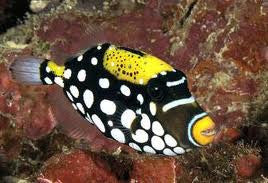
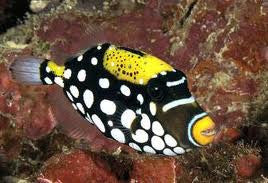
The background coloration is black. Half of inferior part of the body is marked with big white spots which are more or less round. The area around the first dorsal fin is crossed by yellowish sinuosities which draw like a network reminding the leopard’s patterns. There is a yellowish ring around the mouth, which is surrounded by another fin white ring. A white stripe ride the snout just under the eyes level. The second dorsal fin and the anal fin are white and underlined with a yellow line at their base. The caudal peduncle has a yellowish blotch on its top part and has three horizontal sets of spiny scales. The caudal fin is yellowish in its center and has black margin. Juveniles have a black background coloration spangled with small white spots, the extremity of the snout and the base of the first dorsal fin is yellowish.
These scales are thick, weakly overlapping, with a rhomboid shape. Each scale has two layers: the topmost layer being bone and the lower layer being collagenous.[5]
This fish has teeth that continuously grow. These teeth help them when feeding on crustaceans.
Clown Triggerfish In aquariums
This fish is a highly prized aquarium fish.
The juvenile clown triggerfish are sought out after more than adults since juveniles are less aggressive towards other fish. Like many other triggerfish, it can require a large aquarium and be aggressive towards other fish. It should not be kept with small fish. Clown triggerfish can be housed with other large fish species such as moray eels and angelfish, but they thrive when kept alone. It will also prey on invertebrates in the aquarium. This fish can become tame enough to be hand-fed; however, one should beware of the fish’s sharp teeth. They have been known to take out chunks of flesh while being hand-fed.
Decor in their tanks must be tough, as clown triggerfish will attack them.
There is high demand of the clown triggerfish in aquariums, and all captive specimens are caught in the wild. This can lead to local populations being impacted.[1]
The clown triggerfish, or any triggerfish should not be one of the first fish added to an aquarium. They should be one of the last ones, if not the last fish added as they will most likely not see their tank mates as potential food sources. Any fish or crustaceans added after the triggerfish is added is seen as food and usually attacked quickly.
The Clown Triggerfish has a beautiful coloration, thus making it a most sought after addition to any home aquarium. Among the most colorful, the Clown Triggerfish is also one of the most aggressive popular inhabitants of an aquarium. Take special care in selecting its tank mates, choose other aggressive, large fish. The tank decor should be chosen with the knowledge that the Clown Triggerfish will rearrange it. They can be found along the inner and outer portions of a reef in the wild, and wherever shellfish and other invertebrates are found.The Clown Triggerfish needs a varied diet of meaty foods including; squid, krill, clams, small fish and hard shelled shrimp to help wear down their ever growing teeth.


- Vestibulum penatibus nunc dui adipiscing convallis bulum parturient suspendisse.
- Abitur parturient praesent lectus quam a natoque adipiscing a vestibulum hendre.
- Diam parturient dictumst parturient scelerisque nibh lectus.